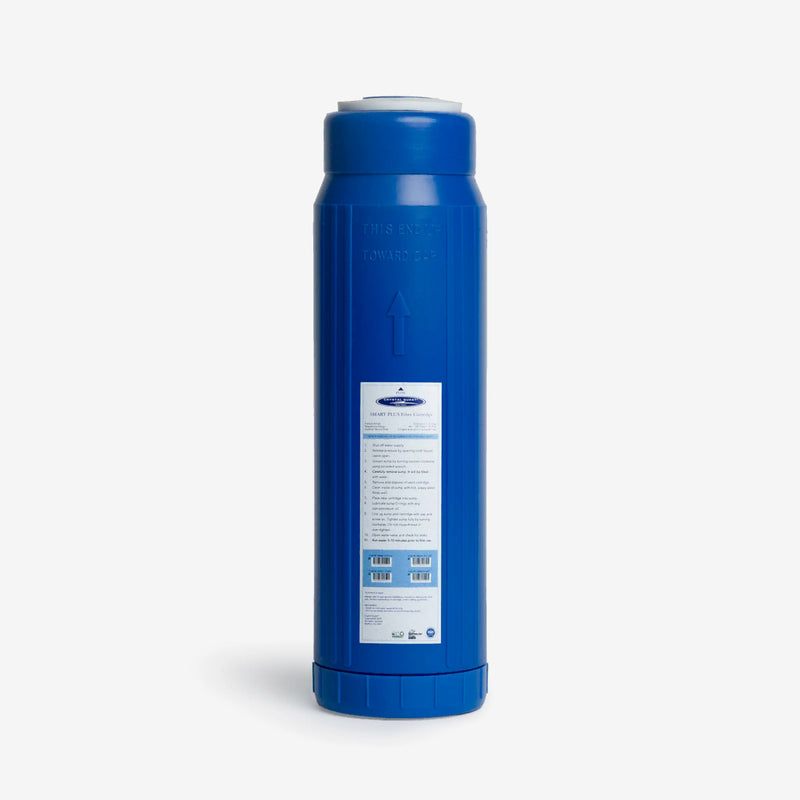
$40.92
Regular price $44.00
SKU CQE-RC-04063
Save $3.08 compared with one-time purchase
A standard 1.75 x 11.75 inch membrane for residential 2 x 12 inch membrane housings, including the optional 75 GPD stage in Crystal Quest Thunder under-sink...
Read moreCouldn't load pickup availability
Overview
Your TDS meter used to read low on the RO faucet. Now the number is creeping toward what comes out of the kitchen tap. That is the clearest sign a reverse osmosis membrane is wearing out, and swapping it brings the system back to the water you bought it for.
This 75 GPD thin film composite (TFC) membrane is the optional membrane listed for Crystal Quest Thunder under-sink RO systems, whose standard membrane is 100 GPD. If your system already runs a 75 GPD membrane and you want to keep that rating, this is the matching replacement. It measures 1.75" x 11.75" for 2" x 12" residential membrane housings and reduces dissolved contaminants, including lead, mercury, cadmium, trivalent chromium, fluoride, nitrates, sodium and radium.
At a glance
- Like-for-like replacement for a 75 GPD membrane in a Thunder under-sink RO
- Brings RO-water TDS back down when the old membrane has worn out
- Standard residential size, 1.75" x 11.75", part CQE-RC-04063
- Up to 99% reduction of dissolved solids (TDS)
- 2 to 3 years of service, depending on feed water quality, system configuration and usage
What you are looking at
The membrane is a spiral wound roll. Flat sheets of TFC membrane, separated by polyethylene netting, wrap around a perforated center tube and sit inside polyolefin wraps. Polypropylene end caps and Buna-N gaskets seal it in the housing, and the two small O-rings mark the end that goes in first.
How a 75 GPD RO membrane works
What happens at the membrane surface
The working surface of a TFC membrane is a polyamide film far thinner than the support layers beneath it. Under pressure, water molecules work their way through that film. Dissolved salts and metals, carried in water as charged ions, are held back and swept away by the water flowing across the surface.
Two streams leave the membrane
Purified water (permeate) collects in the center tube and fills your storage tank. Everything the membrane rejected leaves in the concentrate stream to the drain, and that steady flow is what keeps the surface from clogging. Crystal Quest RO systems send 1 gallon to drain for every 1 to 3 gallons of purified water.
Your 75 GPD in a real kitchen
The rating is the membrane's daily production at its standard test conditions. In a home, output moves with the seasons and the plumbing. Cold winter water moves through the membrane more slowly, low water pressure gives it less push, and high-TDS water pushes back. Pressure matters for purity too: water pressure affects both how much water the membrane makes and how well it rejects dissolved solids.
Gases and small molecules
Dissolved gases and some very small uncharged molecules pass a membrane more easily than salts do. That is why the carbon stages before the membrane and the polishing stage after it are part of every Thunder system.
What shortens membrane life
Chlorine attacks the polyamide film and the damage does not reverse, so the carbon pre-filters must stay current. Hard water can deposit a crystallized layer of scale on the surface, and very hard water should be softened ahead of RO. A system left unused for weeks lets water sit stale in the housings.
What it reduces
Primary target: total dissolved solids, including lead, mercury, cadmium, trivalent chromium, fluoride, nitrates, sodium and radium.
Handled by the system's other stages: chlorine and chloramine, taste and odor, and UV treatment on Thunder 3000 and 4000 models.
Why Crystal Quest
- Made for Crystal Quest systems: the 75 GPD membrane listed for Thunder, with its own part number, so you replace like with like.
- Clear guidance on ratings: 100 GPD is the Thunder standard and 75 GPD remains available; we will tell you which suits your system.
- Over 1,000,000 people served since 1994. Crystal Quest builds under ISO 9001 quality management, has made water filtration in the USA for over 30 years and offers lifetime support by phone, email or chat.
Where it fits
- Crystal Quest Thunder under-sink RO systems running the optional 75 GPD membrane. The standard Thunder membrane is the 100 GPD membrane.
- Housing: 2" x 12" residential membrane housing; membrane size 1.75" x 11.75".
Once a membrane is opened or used it cannot be returned, so check the rating and part number on your current membrane, or ask Crystal Quest, before you order.
Common questions
Is 75 GPD the standard Thunder membrane?
No. Every Thunder under-sink RO system comes standard with the 100 GPD membrane. The 75 GPD membrane is listed as an optional replacement and remains available.
Is a higher GPD rating always better?
GPD is the membrane's rated daily production, not faucet flow. Real output changes with water pressure, temperature and TDS. Use the rating your system lists, and ask Crystal Quest before changing it.
How do I know my 75 GPD RO membrane needs replacing?
Compare tap-water and RO-water TDS. If the RO reading keeps rising, or production stays low with fresh pre-filters and normal pressure, the membrane is due. Most last 2 to 3 years.
Does the 75 GPD membrane fit any 2" x 12" housing?
It is a 1.75" x 11.75" residential membrane listed for Crystal Quest Thunder systems. For any other system, check its manual or ask Crystal Quest before ordering.
What ruins an RO membrane early?
Chlorine reaching the membrane through exhausted carbon pre-filters, scale from very hard water, and long periods without use.
How do I replace the membrane?
Turn off the water, unscrew the membrane housing cap, pull out the old membrane and push the new one in, end with the two small O-rings first, until it is fully seated. Then reconnect, check for leaks and flush as your system manual directs.
Specifications
Specifications for your selection
Single
- SKU
- CQE-RC-04063
- Diameter (width)
- 1.75 in
- Length (height)
- 11.75 in
- Replace every
- 2 to 3 years
Specifications for your selection
Single
- SKU
- CQE-RC-04063
- Diameter (width)
- 1.75 in
- Length (height)
- 11.75 in
- Replace every
- 2 to 3 years
Specifications for your selection
Pack of 2
- SKU
- CQE-RC-04063-2PK
- Diameter (width)
- 1.75 in
- Length (height)
- 11.75 in
- Replace every
- 2 to 3 years
Specifications for your selection
Pack of 4
- SKU
- CQE-RC-04063-4PK
- Diameter (width)
- 1.75 in
- Length (height)
- 11.75 in
- Replace every
- 2 to 3 years
- Membrane type
- Thin-film composite (TFC) reverse osmosis membrane
- Production rating
- 75 GPD (gallons per day)
- Part number
- CQE-RC-04063
- Membrane size
- 1.75" x 11.75"
- Housing format
- 2" x 12" residential membrane housing
- Listed replacement for
- Crystal Quest Thunder under-sink RO systems (optional membrane; the standard is 100 GPD)
- Construction
- Polypropylene end caps, polyolefin inner and outer wraps, polyethylene netting, Buna-N gasket end caps
- Operating pressure
- 20 to 60 psi (1.4 to 4.1 bar)
- Operating temperature
- 40°F to 90°F (4°C to 32°C)
- Replacement interval
- 2 to 3 years; actual life depends on feed water quality, system configuration and usage
Performance curves
Rated 75 GPD at 77°F (25°C), 50 psi, 250 ppm feed.
Data for Figure 1
| Feed temperature | 40 psi | 50 psi | 60 psi |
|---|---|---|---|
| 40°F (4°C) | 28 | 35 | 43 |
| 50°F (10°C) | 34 | 44 | 53 |
| 60°F (16°C) | 42 | 54 | 65 |
| 70°F (21°C) | 52 | 66 | 80 |
| 77°F (25°C) | 59 | 75 | 91 |
| 85°F (29°C) | 67 | 85 | 104 |
| 90°F (32°C) | 73 | 92 | 112 |
Values in GPD (gallons per day).
Data for Figure 2
| Feed pressure | 50°F (10°C) | 60°F (16°C) | 77°F (25°C) |
|---|---|---|---|
| 10 psi | 6 | 8 | 11 |
| 20 psi | 16 | 19 | 27 |
| 30 psi | 25 | 31 | 43 |
| 40 psi | 34 | 42 | 59 |
| 50 psi | 44 | 54 | 75 |
| 60 psi | 53 | 65 | 91 |
Values in GPD (gallons per day).
Crystal Quest engineering data. Typical values calculated from the element's rated output at standard test conditions; actual output depends on feed water, recovery, storage tank back pressure and element condition.
Membrane specifications
| Specification | Value |
| Membrane type | Thin-film composite (TFC) reverse osmosis membrane |
| Production rating | 75 GPD (gallons per day) |
| Part number | CQE-RC-04063 |
| Membrane size | 1.75" x 11.75" |
| Housing format | 2" x 12" residential membrane housing |
| Listed replacement for | Crystal Quest Thunder under-sink RO systems (optional membrane; the standard is 100 GPD) |
| Construction | Polypropylene end caps, polyolefin inner and outer wraps, polyethylene netting, Buna-N gasket end caps |
| Operating pressure | 20 to 60 psi (1.4 to 4.1 bar) |
| Operating temperature | 40°F to 90°F (4°C to 32°C) |
| Salt rejection | Up to 99% |
| Chlorine | Remove ahead of the membrane with carbon pre-filtration |
| Drain water (Crystal Quest RO systems) | 1 gallon to drain for every 1 to 3 gallons of purified water |
| Service life | 2 to 3 years* |
*Service life is an estimate. Actual life depends on feed water quality, system configuration and usage.
Compatibility
Maintenance & care
Reviews
Loading reviews… Reviews could not load. Try again.
Goes well with
-
Ultrafiltration (UF) Water Filter Membrane
$67.00
$56.95
Regular price $67.00, Save $10.05$53.60Regular price $67.00, Save $13.40 -
SMART Filter Cartridge
$59.00
$50.15
Regular price $59.00, Save $8.85$47.20Regular price $59.00, Save $11.80 -
Coconut Based 5-Micron Carbon Block Filter Cartridge
$22.95
$19.51
Regular price $22.95, Save $3.44$18.36Regular price $22.95, Save $4.59 -
Inline Granular Activated Coconut Shell Carbon (GAC) Filter Cartridge
$49.00
$41.65
Regular price $49.00, Save $7.35$39.20Regular price $49.00, Save $9.80